

The State Side
State Management and Operations
Learn the Basics









Approach
Folder Structure
The State is UI and JS Framework agnostic i.e. It allows any framework like React/Bootstap/Vue/Angular to bind with it. All the implementation is purely in JavaScript or TypeScript make it easy to evolve the business to keep its models regardless of evolution of UI.
.
└── state/
    └── item/
        ├── item.initial.js
        ├── item.type.js
        ├── item.reducer.js
        ├── item.selectors.js
        ├── item.operations.js
        └── item.helper.js
Non asyncronous activity do not require operations file and purely work with
Architecture
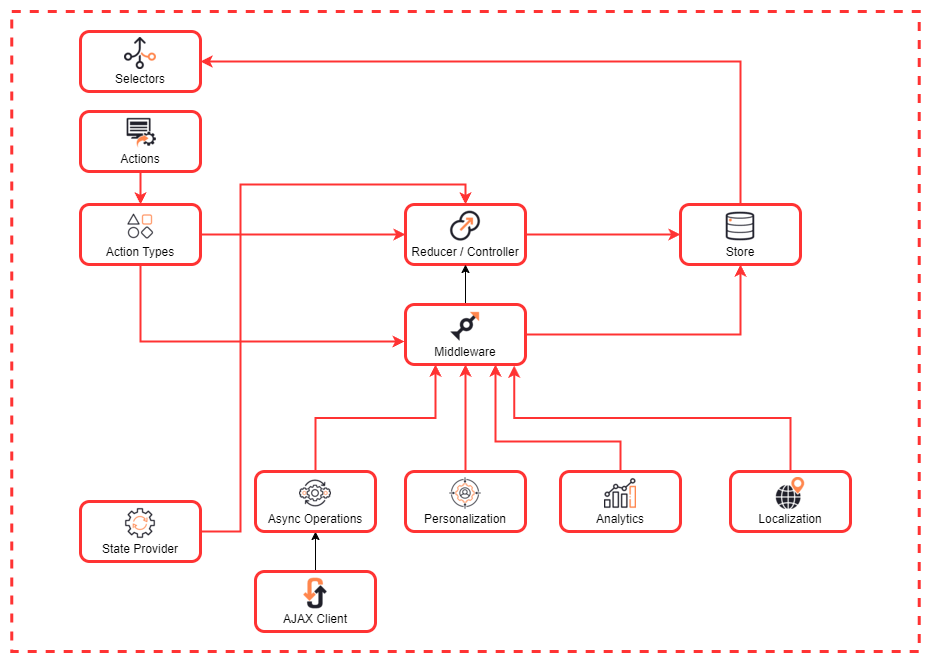
Remember when MapDispatch and MapStateToProps were very famous initially? Further, React got more external non-frontend dev involved without asking why React. Grand-scale involvement of the community demanded faster delivery and hence the community thought that MapDispatch to MapStateToProps was a slow technique and moved forward stateless function-based approach. Such solutions were non-maintainable non-bulletproof, and non-scalable and were designed as a cash grab to extract money out of the clients. Rather than having an out of box analysis, they skipped steps to earn money. Detailed Analysis would have made them realize that 90% of the code is repetitive or prebuilt with CSS Framework. The 10% that you have to work on are specific points i.e. Build the organism with CSS framework components and collective API response mapping for reducer that would eventually pass it on to the organism. State Operations have evolved from MapState and MapDispatch to queries and mutations.
            page
            |
            template
            |
Organism - Container - State
            |
            Chunk Config
            |
            Widget
            |
            Other MFE Page
Key Concept 1:
Organizing state for Organisms
Naming Selection
- Action Name String in underscores
- Action Function CRUD namimg convention in camelCase
- camelCase API names in suffix of API
- camelCase Operation name in suffix Operation
- Helper and Selectors function with get and set as prefix of variable name
Key Concept 2:
Operations Sequencing
- Inserting Loading States on your scaffolding to support Sync
- Active
- Passive
- Partial Passive
Adopting CRUD Naming
- Create[Item]
- Read[Items]
- Read[Item]
- Update[Item]
- Update[Prop][Item]
- Delete[Item]
Key Concept 3:
Optimizing Selectors
Scaling with MicroFrontend
State can be used indepedently as common state in state tree to provide access to common business logic through out the business unit. With expansion of modularing with micro services/frontend, It has become quintessential to include common state throughout the platform. Using this architecture tactic, common reducer mechanism is possible
Third Party Integration
If organism and state are pure designed with JSON Scaffolding, third party integration (data measurement ops and personalization) becomes seamless. All the measurement of event or personalization for data can be simulated by modulation the incoming data properties and outgoing events of the organisms. Below is example for overide in state