

Frontend State Architecture
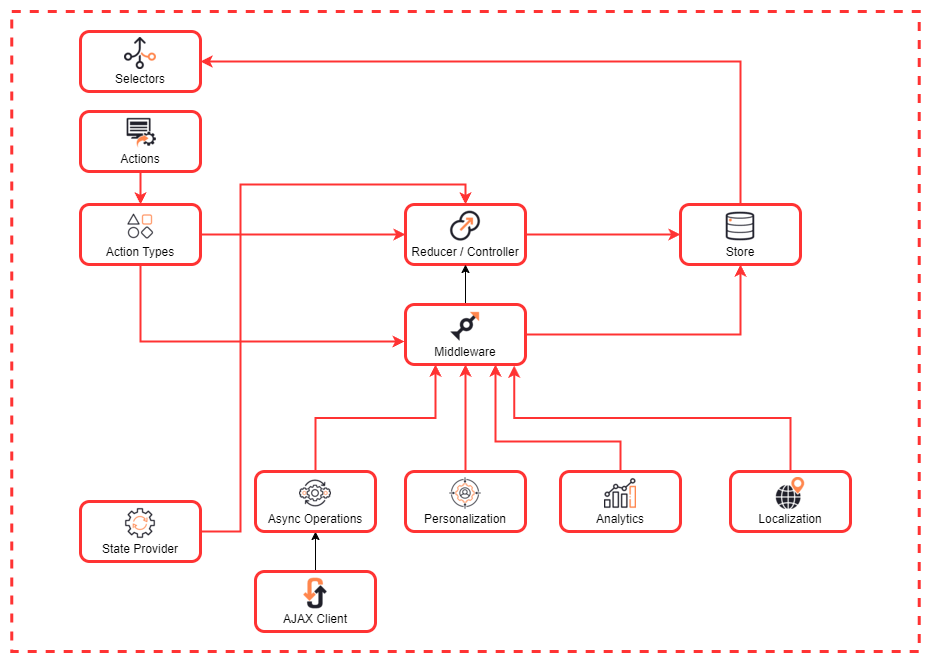
The image represents a typical architecture for managing state in a frontend application, likely using a state management library such as Redux. Below is an explanation of the components and their interactions:
Key Components
- Selectors:
- Functions used to extract specific pieces of data from the store.
- They interact with the store to retrieve data for use in the application.
- Actions:
- Represent events or intentions in the application (e.g., user interactions).
- Actions are dispatched to trigger changes in the application’s state.
- Action Types:
- Define unique identifiers for actions (e.g.,
ADD_ITEM,REMOVE_ITEM). - These are used by reducers to determine what kind of state update is required.
- Define unique identifiers for actions (e.g.,
- Reducer/Controller:
- Pure functions that take the current state and an action, then return a new state.
- Responsible for updating the store based on dispatched actions.
- Store:
- A centralized location where the entire application state is maintained.
- Acts as a single source of truth for the app’s data.
- Middleware:
- Functions that sit between actions being dispatched and reducers processing them.
- Used for handling side effects like asynchronous operations, logging, analytics, etc.
- State Provider:
- A wrapper component that provides access to the store throughout the application.
- Ensures components can connect to and interact with the store.
- Async Operations:
- Handles asynchronous tasks such as API calls or database queries.
- Often managed through middleware like
redux-thunkorredux-saga.
- Personalization:
- Middleware or logic responsible for tailoring app behavior or content based on user preferences or context.
- Analytics:
- Middleware that tracks user interactions and sends data to analytics platforms.
- Localization:
- Middleware or logic that adapts content based on language or region settings.
- AJAX Client:
- Facilitates communication with external APIs or servers for fetching or sending data.
Workflow
- Actions are dispatched by components or logic in response to user interactions or events.
- Middleware intercepts these actions to handle side effects (e.g., async tasks, logging).
- The reducer processes the action and updates the store with new state.
- Selectors retrieve updated state from the store for use in components.
- The State Provider ensures all components have access to the store’s data.
This architecture promotes predictable state management, scalability, and separation of concerns in frontend applications.